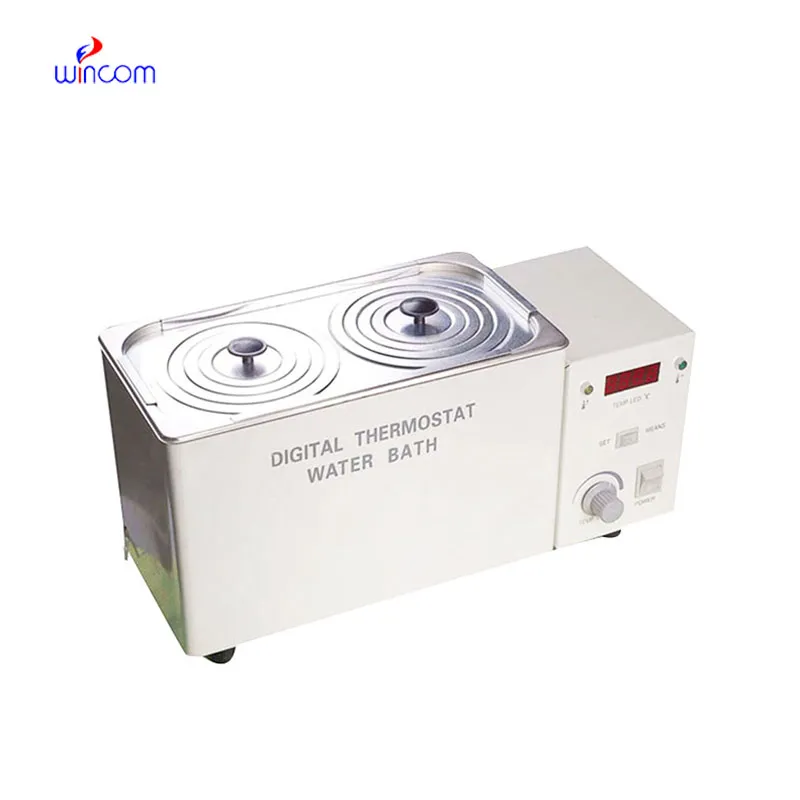
The laboratory circulating water bath has cutting-edge temperature control and ergonomic design for consistent laboratory performance. It provides uniform heat distribution to prevent overheating or warping of the sample. The stainless-steel chamber of the laboratory circulating water bath is durable and corrosion resistant. Its digital interface provides precise settings, with inbuilt safety features protecting against hot temperatures. The compact design does not sacrifice capacity. With low maintenance requirements and smooth operation, the laboratory circulating water bath proves an efficient instrument for scholarly, medical, and research organizations.

The laboratory circulating water bath is a necessary instrument for temperature-sensitive procedures. In molecular biology, it supports enzyme reactions such as PCR preparation and DNA extraction. It is also widely employed in protein denaturation, tissue incubation, and thawing of samples. The laboratory circulating water bath facilitates uniform heating, which is necessary when handling biological materials with stable requirements. Applied in industrial research for viscosity measurement and material analysis, its versatility makes the laboratory circulating water bath apply in both research and production settings requiring precise temperature control.
The future of laboratory circulating water bath is one of automation and intelligent design. Intelligent diagnostics will be built into the new models that recognize abnormal temperature behavior and adjust in real-time. Integration into digital laboratory platforms will allow for data synchronization for traceability and compliance. The laboratory circulating water bath will be more energy efficient with smarter heating coils and improved insulators. Because labs demand higher accuracy and environmental sensitivity, the laboratory circulating water bath will remain a standard in today's research laboratories.

The laboratory circulating water bath are durable due to ongoing cleaning and examination. Mineral deposit will affect thermal stability, and the bath thus requires draining and cleaning regularly. Distilled or deionized water must be used to prevent scaling. Calibration of the temperature controller from time to time maintains the readings in order. The control surface and outer casing can be cleaned using a damp cloth. Be sure to disconnect the power source during maintenance. These simple steps keep the laboratory circulating water bath in their optimal working state.
A laboratory circulating water bath is a precision heating equipment designed for laboratory purposes where constant temperature conditions are required. Typically used for sample incubation, substance melting, or induction of biochemical reactions, the laboratory circulating water bath combines accurate temperature control with efficient water flow for even heat distribution. Its digital display and safety cut-off features enhance operating reliability. Rugged and easy to maintain, the laboratory circulating water bath is a basic laboratory equipment in different scientific disciplines.
Q: What makes a water bath important for laboratory precision? A: Its ability to maintain constant, uniform temperature conditions ensures reproducibility and accuracy in experimental results. Q: Can deionized water be used instead of distilled water? A: Yes, deionized water is also suitable, as it minimizes mineral deposits and supports cleaner operation. Q: How should a water bath be stored when not in use? A: Drain the tank completely, wipe it dry, and keep it covered in a clean, dust-free area to prevent corrosion and contamination. Q: What are common signs that a water bath requires maintenance? A: Slow heating, fluctuating temperatures, or visible residue in the tank indicate that cleaning or inspection is needed. Q: How can user safety be improved when using a water bath? A: Always use insulated gloves, avoid contact with hot water, and ensure the equipment is placed on a stable, dry surface during operation.
The hospital bed is well-designed and very practical. Patients find it comfortable, and nurses appreciate how simple it is to operate.
The delivery bed is well-designed and reliable. Our staff finds it simple to operate, and patients feel comfortable using it.
To protect the privacy of our buyers, only public service email domains like Gmail, Yahoo, and MSN will be displayed. Additionally, only a limited portion of the inquiry content will be shown.
We’re interested in your delivery bed for our maternity department. Please send detailed specifica...
Hello, I’m interested in your water bath for laboratory applications. Can you confirm the temperat...
E-mail: [email protected]
Tel: +86-731-84176622
+86-731-84136655
Address: Rm.1507,Xinsancheng Plaza. No.58, Renmin Road(E),Changsha,Hunan,China


 EN
EN
 af
af
 es
es
 ar
ar
 tr
tr
 sw
sw
 pt
pt
 th
th
 ur
ur
 bn
bn
 ne
ne
 vi
vi
 km
km
 lo
lo
 de
de
 ru
ru
 fi
fi
 nl
nl
 fa
fa
 fr
fr
 ko
ko