Being a crucial device for monitoring patients medically, the patient vital sign monitor offers a simultaneous ECG and vital signs display for patient evaluation. The apparatus aids in the acquisition of stable signals and the depiction of clear waveforms, which enable the medical personnel to keep track of the physiological trends very effectively. Its usage is not limited to one department only, but rather, it is found throughout the hospital where continuous monitoring and data review are done consistently during diagnosis, treatment, and recovery.

In hospital intensive care units, patient vital sign monitor is utilized for the incessant monitoring of critically ill patients. The instantaneous ECG monitoring enables doctors to not only see the changes in heart rhythm but also follow the vital signs during the long periods of observation. This use helps to detect the physiological instabilities early and aids the medical personnel in providing constant supervision. With its continuous presence, patient vital sign monitor turns into an indispensable tool for the critical care processes in the hospital settings.
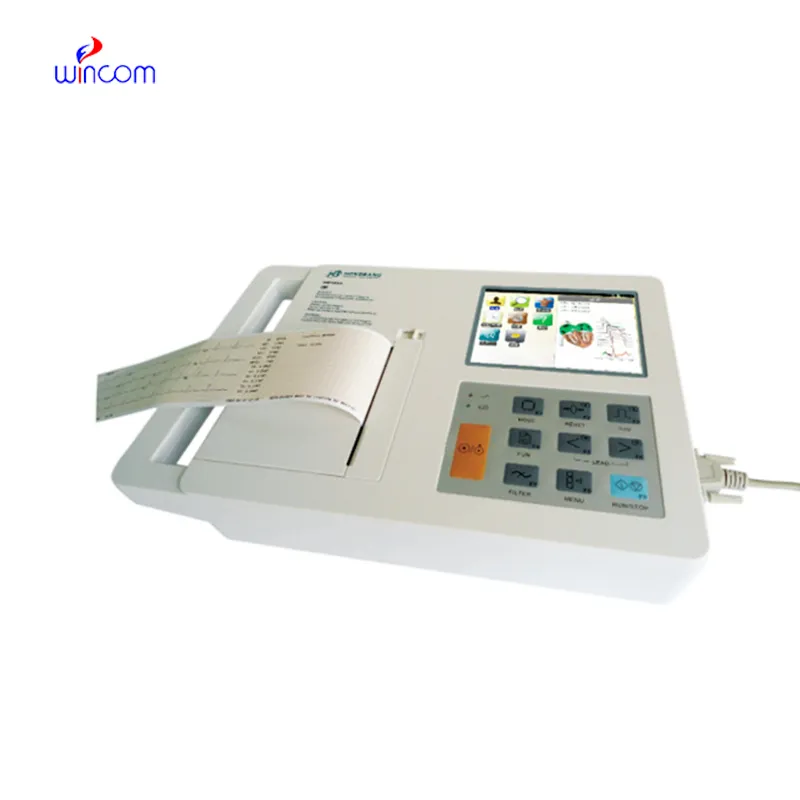
Eventually, patient vital sign monitor will be considered as a vital part of integrated patient management platforms in the long run. The ongoing ECG data will play a major role in forming all-inclusive physiological profiles that will aid in the great collaboration of medical practitioners. This change will reinforce patient monitoring methods in the current healthcare systems.
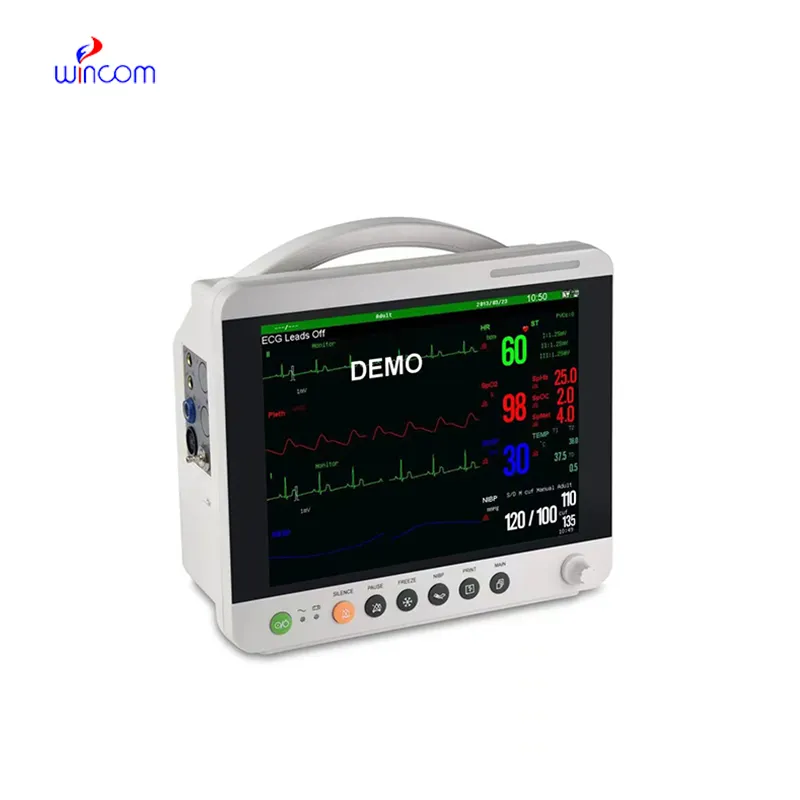
The appropriate patient vital sign monitor handling is initially by disinfecting surfaces and display-mounts routinely with hospital-grade disinfectants. Regular checks of sensors, wires, and ECG leads for possible wear or damage should be conducted. It is necessary to keep the machinery in a controlled environment to avoid the threats of moisture, dust, or vibration. Moreover, frequent software updates will help in keeping the data processing accurate and the alarm working reliably. Adherence to systematic maintenance schedules is the way to ensure the precision of the measurement, the support of long-term functionality, and the reliability of patient vital sign monitor as an instrument spread over hospital wards, ICUs, and clinical labs.
During patient transport, patient vital sign monitor offers real-time cardiac monitoring in emergency transport and mobile medical units. ECG data is continuously accessible during the whole transfer process and is very useful for keeping an eye on the patient. This feature not only bolsters the continuity of care among the different departments but also secures the precise monitoring of the patient's condition during the most critical transitions of the hospital systems.
Q: How often should ECG electrodes be replaced? A: Signal detection accuracy depends on the regular replacement of electrodes. Q: Can a Patient Monitor & ECG be used in neonatal care? A: Certainly, the use of specialized sensors allows safe monitoring of newborns and infants. Q: Does a Patient Monitor & ECG provide alarm functions? A: Alarms are indeed present, with notifications sent to the staff in case of abnormal heart rates or any other vital sign changes. Q: Can it record trends over time? A: It can indeed show historical data for patient analysis and clinical evaluation. Q: Is maintenance required for a Patient Monitor & ECG? A: Long-term performance and accuracy depend on regular maintenance and cleaning which are appropriate for the equipment.
This ultrasound scanner has truly improved our workflow. The image resolution and portability make it a great addition to our clinic.
The centrifuge operates quietly and efficiently. It’s compact but surprisingly powerful, making it perfect for daily lab use.
To protect the privacy of our buyers, only public service email domains like Gmail, Yahoo, and MSN will be displayed. Additionally, only a limited portion of the inquiry content will be shown.
We’re looking for a reliable centrifuge for clinical testing. Can you share the technical specific...
I’m looking to purchase several microscopes for a research lab. Please let me know the price list ...
E-mail: [email protected]
Tel: +86-731-84176622
+86-731-84136655
Address: Rm.1507,Xinsancheng Plaza. No.58, Renmin Road(E),Changsha,Hunan,China


 EN
EN
 af
af
 es
es
 ar
ar
 tr
tr
 sw
sw
 pt
pt
 th
th
 ur
ur
 bn
bn
 ne
ne
 vi
vi
 km
km
 lo
lo
 de
de
 ru
ru
 fi
fi
 nl
nl
 fa
fa
 fr
fr
 ko
ko